
Modern Digital Lifestyle – In 2026, the digital lifestyle is more than just gadgets. It is a seamless system that shapes our daily work and life. Furthermore, the Modern Digital Lifestyle now serves as the main foundation for how we live today. This evolution creates an integrated reality. Consequently, artificial intelligence and automated living define our professional success.
Explore more updates at the NGEONLINE Home Page for global digital insights.
Executive Summary: Modern Digital Lifestyle Pillars
| Core Pillar | Primary Focus | Target Outcome |
|---|---|---|
| Smart Living | IoT integration and Matter-standard automation. | Seamless domestic efficiency. |
| Digital Productivity | AI agents and holographic collaboration tools. | High-level creative output. |
| Connectivity | 6G networks and LEO satellite constellations. | Zero-latency global access. |
| Digital Wellness | Scheduled Dark Hours and neural recovery. | Sustainable mental health. |
Essential Traits of a Modern Digital Lifestyle
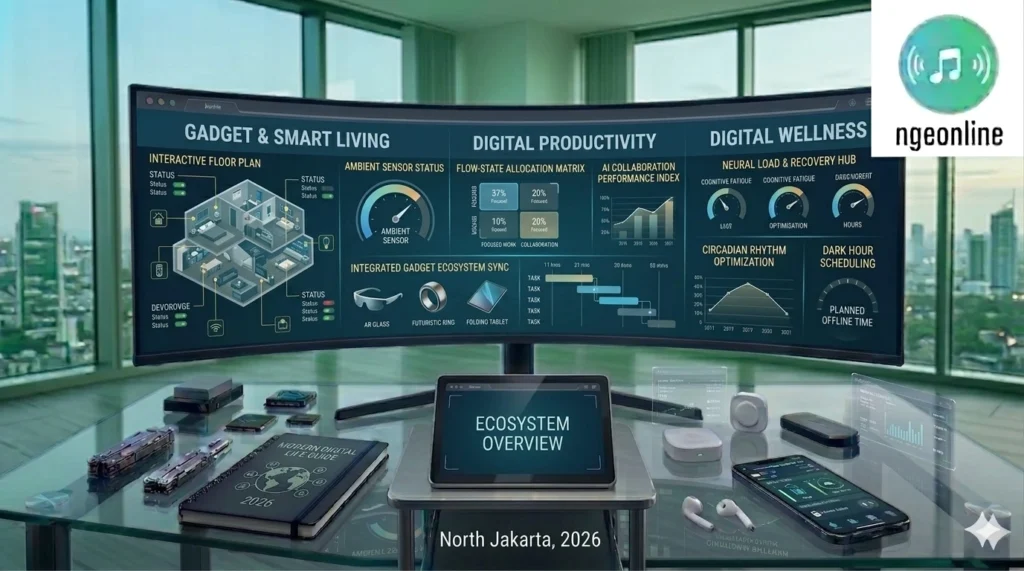
Modern living now relies on predictive tools and ambient tech. Specifically, these systems characterize the modern digital experience. In addition, high-authority data from Statista shows that households now manage over 25 devices. However, we must use these tools wisely to remain efficient. Therefore, understanding this tech ecosystem is vital for everyone.
Gadget & Smart Living
Smart living in 2026 focuses on the Internet of Things (IoT). In fact, IoT integration anchors smart living into every part of the home. Moreover, new Matter-compatible devices help different systems talk to each other. As a result, your security and energy use become much easier to manage. Additionally, wearable tech now tracks health with clinical precision.
Future Trends in Gadget & Smart Living
In addition to basic automation, the future of Gadget & Smart Living involves deep sensory integration. Specifically, smart environments now adapt to your mood and circadian rhythms automatically. Furthermore, the rise of energy-efficient smart grids allows your devices to minimize power costs during peak hours. Consequently, these intelligent systems provide both comfort and sustainability. Therefore, investing in compatible smart hardware is a crucial step for any modern household.
Digital Productivity
“Hybrid Presence” has now superseded old remote work models. Indeed, holographic tech enables deep collaboration from any distance. Furthermore, AI agents now handle complex project tasks. Consequently, professionals can focus on creative strategy instead of busy work. However, mastering these AI tools requires constant learning and adaptation.
Advancing Your Digital Productivity with AI
Modern professionals now use autonomous agents to revolutionize their Digital Productivity. Specifically, these AI tools manage complex scheduling and data analysis without human intervention. Furthermore, the integration of generative assistants streamlines content creation and project management tasks. Consequently, this shift allows team members to focus on high-level creative strategy. Therefore, adopting these automated workflows remains essential for staying competitive in the 2026 market.
Digital Wellness of a Modern Digital Lifestyle
Digital health is now a top priority for tech users. Notably, recent studies by Pew Research highlight the risks of digital burnout. Therefore, the Modern Digital Lifestyle incorporates scheduled “Dark Hours.” During these times, users sever all non-essential links to help the brain recover. Ultimately, this balance ensures long-term mental health in a connected world.
Strategic Methods for Long-Term Digital Wellness
Maintaining Digital Wellness requires more than just manual tracking of screen time. Specifically, modern users utilize AI-driven biofeedback to monitor their cognitive load in real-time. Furthermore, these tools provide gentle nudges to encourage periodic mental breaks. Consequently, this proactive approach prevents the onset of digital fatigue and stress. Therefore, integrating these health-focused technologies into your routine ensures a sustainable relationship with your devices.
Infrastructure & Connectivity Standards (2026)
| Technology Component | Primary Function | Modern Advantage |
|---|---|---|
| 6G Networks | Core Data Transmission | Sub-millisecond latency and Terahertz speeds. |
| Matter Protocol | Universal Language | Cross-brand compatibility (Apple, Google, Amazon). |
| Thread Mesh | Device Connectivity | Self-healing network with low power consumption. |
| LEO Satellites | Global Reach | High-speed internet in remote geographic areas. |
| SSI Protocols | Identity & Privacy | User-owned data without central authority control. |
Deep Dive: The Modern Digital Lifestyle Evolution of Connectivity
The foundation of any Modern Digital Lifestyle rests on the speed and reliability of its connection. Currently, we are transitioning from the limitations of 5G into the expansive era of 6G technology. Specifically, 6G introduces Terahertz (THz) frequencies that offer speeds up to 100 times faster than current standards. Furthermore, the integration of Low Earth Orbit (LEO) satellite constellations, such as Starlink’s advanced generations, ensures global coverage. Consequently, dead zones in digital connectivity no longer exist, even in the most remote geographic locations.
This shift significantly impacts the latency of smart home ecosystems. In the past, cloud-based commands often suffered from noticeable delays. However, 6G and edge computing reduce this latency to sub-millisecond levels. As a result, your smart home reacts to your presence and voice commands with biological speed. Moreover, this hyper-connectivity enables real-time synchronization between your home environment and your mobile devices. Therefore, the physical distance between the user and their data no longer hinders the digital experience.
Additionally, the bandwidth provided by these new networks supports high-fidelity holographic streaming. In fact, 6G makes it possible to transmit complex 3D environments without compression artifacts. Consequently, this technological leap supports the “Hybrid Presence” mentioned earlier in this guide. By removing these bandwidth bottlenecks, the Modern Digital Lifestyle becomes truly immersive and pervasive. Ultimately, connectivity in 2026 functions like oxygen—essential, invisible, and everywhere.
AI Ethics and the Preservation of Human Agency
As automation increases, the question of human agency becomes critical. Specifically, the Modern Digital Lifestyle relies heavily on predictive algorithms that anticipate user needs. However, this convenience carries the risk of “algorithmic bias” or the loss of personal choice. Therefore, ethical AI frameworks must guide how these systems interact with our private lives. In 2026, users prioritize “Explainable AI” (XAI) tools that provide transparent reasons for every automated suggestion or action.
Maintaining control requires a proactive approach to digital autonomy. Specifically, modern platforms now feature “Human-in-the-Loop” (HITL) settings. Furthermore, these settings ensure that the final decision for major life actions remains with the human user. For instance, an AI might suggest a financial investment, but it cannot execute the trade without biometric confirmation. Consequently, technology acts as a powerful advisor rather than an autonomous ruler. Moreover, this balance prevents the erosion of critical thinking skills in a world of automated answers.
In addition, data sovereignty has become a cornerstone of digital ethics. Specifically, users now demand decentralized storage solutions to protect their personal information. Consequently, the Modern Digital Lifestyle utilizes “Self-Sovereign Identity” (SSI) protocols. These protocols allow individuals to own their data and only grant temporary access to service providers. Therefore, we can enjoy the benefits of AI without sacrificing our fundamental right to privacy and digital self-determination.
Connecting the Home to Smart City Infrastructures
The Modern Digital Lifestyle does not stop at the front door of your house. Instead, it integrates seamlessly with the broader smart city infrastructure. Specifically, your smart home communicates with the city’s energy grid to optimize power consumption. Furthermore, automated transportation systems sync with your personal calendar to ensure a vehicle is ready exactly when you need it. As a result, the entire urban environment functions as an extension of your personal digital ecosystem.
Urban living in 2026 also utilizes advanced “Digital Twins” of entire neighborhoods. Specifically, these digital replicas allow city planners to simulate traffic patterns and environmental impacts in real-time. Consequently, citizens receive live updates regarding air quality, noise levels, and public safety directly on their wearables. Moreover, this data allows the Modern Digital Lifestyle to be more sustainable and community-oriented. Therefore, technology helps us build cleaner and more efficient cities for everyone.
Case Studies: Digital Transformation of a Modern Digital Lifestyle in 2026

Scenario A: The Autonomous Professional
Consider the daily routine of a graphic designer in 2026. Specifically, her AI assistant handles all client invoicing and file management during her sleep. Furthermore, when she begins work, her smart environment adjusts the lighting and temperature to her “Deep Work” preferences. Consequently, she spends 90% of her time on creative tasks rather than administrative overhead. Ultimately, this case demonstrates how a Modern Digital Lifestyle maximizes human potential by eliminating routine drudgery.
Scenario B: The Proactive Health Monitor
Another example involves an elderly user living alone. Specifically, his smart home uses passive sensors to monitor his gait and heart rate. In fact, the system recently detected an irregular rhythm before he felt any symptoms. Immediately, the AI contacted his physician and updated his electronic health records. Therefore, the technology provided life-saving intervention without the need for manual monitoring. This scenario highlights the vital role of digital wellness in modern society.
Technical Deep Dive: The Matter and Thread Protocols
To achieve a truly unified Modern Digital Lifestyle, devices must speak the same language. Specifically, the Matter protocol has solved the problem of ecosystem fragmentation. Furthermore, Matter allows devices from Apple, Google, and Amazon to work together seamlessly. Moreover, Thread serves as the underlying mesh network that connects these devices. Unlike Wi-Fi, Thread is low-power and self-healing. Consequently, if one device fails, the rest of the network remains active and stable. Therefore, understanding these protocols is essential for anyone building a reliable smart home in 2026.
Modern Digital Lifestyle Comparison
| Category | Old Tech Style | Modern Style (2026) |
|---|---|---|
| Control | Manual Input | Ambient AI |
| Work | Screen Meetings | Holographic Presence |
| Health | App Tracking | Neural Recovery |
Advanced FAQ: Modern Digital Lifestyle 2026
1. How does 6G technology impact my smart home?
6G provides ultra-low latency and massive bandwidth. Consequently, your smart home devices react instantly and can stream high-fidelity holographic data without delays.
2. Is my privacy safe in an automated digital lifestyle?
Privacy depends on using decentralized protocols. Specifically, adopting Self-Sovereign Identity (SSI) allows you to own your data while still benefiting from AI automation.
3. What is the benefit of a Smart City infrastructure?
Smart cities sync with your personal home grid to optimize energy. Furthermore, they provide real-time updates on urban safety and traffic directly to your wearables.
4. Can I maintain human agency while using AI assistants?
Yes, by using “Human-in-the-Loop” settings. Therefore, you ensure that the AI only acts as an advisor, while you retain the final decision-making power.
5. What are Matter and Thread in smart living?
Matter is a unified communication language, while Thread is a stable mesh network. As a result, gadgets from different brands can finally work together without connection drops.
Conclusion: Embracing the Future of Living
Menerapkan Modern Digital Lifestyle di tahun 2026 memerlukan pemahaman mendalam tentang bagaimana teknologi saling terhubung secara harmonis. Sebagai kesimpulan, transisi menuju jaringan 6G dan satelit orbit rendah telah menghapus batasan geografis dalam produktivitas kita. Selain itu, integrasi protokol seperti Matter dan Thread memastikan bahwa ekosistem rumah pintar Anda beroperasi dengan stabilitas yang belum pernah ada sebelumnya.
Namun, kemajuan ini juga menuntut tanggung jawab etis dan kesadaran akan kesehatan mental melalui praktik digital wellness yang ketat. Oleh karena itu, menjaga kendali penuh atas privasi data dan memberikan ruang bagi pemulihan saraf menjadi kunci utama untuk tetap kompetitif di era otomatisasi ini. Dengan mengadopsi kerangka kerja yang seimbang antara efisiensi AI dan otonomi manusia, kita dapat meraih potensi maksimal dari inovasi masa depan.
Akhirnya, perjalanan menuju transformasi digital yang sempurna adalah proses belajar yang berkelanjutan bagi setiap profesional. NGEONLINE akan terus hadir sebagai rekan setia Anda dalam menyediakan wawasan teknis dan panduan praktis untuk menavigasi kompleksitas dunia digital yang terus berkembang ini.
About the Author