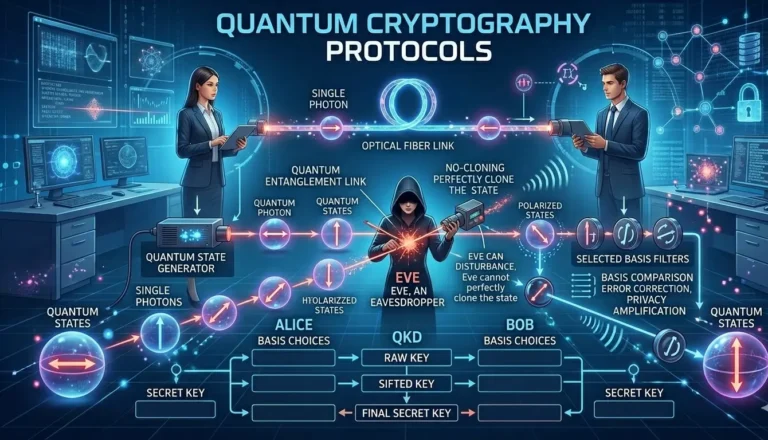

Quantum Cryptography Protocols – In the digital architecture of the 21st century, data is the most valuable currency. However, as we stand on the precipice of the quantum computing revolution, the bedrock of our current encryption methods—mathematical complexity—is beginning to fracture. To maintain data integrity, enterprise leaders and network architects must pivot toward the next frontier of security: Quantum Cryptography Protocols. This transition is not merely an IT upgrade; it is a fundamental shift in how we secure global communication channels against future adversaries.
Table of Contents
- What Are Quantum Cryptography Protocols?
- Why Organizations Must Prioritize Quantum Cryptography Protocols Today
- Operational Challenges When Deploying Quantum Cryptography Protocols
- Comparison: Classical Cryptography vs. Quantum Protocols
- The Mechanics: History and Functionality
- Frequently Asked Questions (FAQ)
- Conclusion
What Are Quantum Cryptography Protocols?
At its core, the term quantum cryptography protocols refers to a set of communication rules and cryptographic methodologies that derive their security from the fundamental laws of quantum physics rather than computational mathematical hardness. Unlike classical encryption (like RSA or ECC) which relies on the assumption that a computer cannot solve a complex math problem in a reasonable timeframe, quantum protocols utilize the properties of quantum mechanics—specifically the uncertainty principle and the no-cloning theorem—to ensure that any attempt to intercept data is physically detectable.
These protocols often manifest through Quantum Key Distribution (QKD). In this setup, two parties, usually referred to as Alice and Bob, use quantum states (typically photons) to transmit a secret key. If an eavesdropper, Eve, attempts to observe these photons, she inevitably disturbs their quantum state. This disturbance alerts the communicating parties, who then discard the compromised key. Essentially, these protocols offer “information-theoretic security,” meaning the protection is absolute, regardless of the computing power an attacker may possess in the future.
Why Organizations Must Prioritize Quantum Cryptography Protocols Today
You might wonder, “If quantum computers are years away from breaking RSA, why should I care about Quantum Cryptography Protocols now?” The answer lies in a strategy known as “Harvest Now, Decrypt Later.”
Sophisticated threat actors are currently harvesting encrypted data traffic from enterprise networks, storing it, and waiting for the moment they have access to a cryptographically relevant quantum computer. If your organization handles sensitive data—be it healthcare records, intellectual property, or financial infrastructure—that data needs to remain secure for 10, 20, or even 50 years. Therefore, the encryption you deploy today must be resilient against the decryption technologies of tomorrow.
Furthermore, integrating these protocols is not an overnight task. It requires a significant overhaul of the current Cybersecurity Infrastructure. By starting the transition now, enterprises can adopt a hybrid approach, layering quantum-resistant algorithms over existing frameworks to ensure a phased, secure migration.
Operational Challenges When Deploying Quantum Cryptography Protocols
While the theoretical benefits are undeniable, the practical deployment of Quantum Cryptography Protocols involves substantial hurdles. First, there is the hardware requirement. QKD requires specialized equipment, such as single-photon detectors and quantum-capable fiber-optic channels, which are not currently standard in most enterprise data centers. Distance is another significant factor; quantum signals are delicate and traditionally suffer from high attenuation over long-range fiber cables, often requiring “trusted nodes” or quantum repeaters to bridge the gap.
Moreover, the integration with existing legacy systems presents a complex software challenge. Most enterprise applications are not “quantum-aware.” Therefore, the migration path usually begins with Post-Quantum Cryptography (PQC)—algorithms designed to run on classical computers but engineered to be resistant to quantum attacks. Implementing these protocols alongside PQC is the current gold standard for enterprise risk management.
Comparison: Classical Cryptography vs. Quantum Protocols
To better understand the paradigm shift, let’s compare the fundamental differences between traditional mathematical approaches and physics-based quantum approaches:
| Feature | Classical Cryptography | Quantum Cryptography Protocols |
|---|---|---|
| Security Basis | Mathematical Complexity (e.g., Prime Factorization) | Fundamental Laws of Physics (Quantum Mechanics) |
| Eavesdropping Detection | Impossible to detect interception | Detectable via state collapse |
| Future-Proofing | Vulnerable to Shor’s Algorithm | Resilient to quantum computation |
| Infrastructure Needs | Standard servers and routers | Specialized photonics and quantum nodes |
The Mechanics: History and Functionality
The history of quantum secure communication traces back to the 1970s and early 1980s, primarily with the conceptualization of the “conjugate coding” by Stephen Wiesner and the subsequent BB84 protocol developed by Charles Bennett and Gilles Brassard. These pioneers realized that by encoding bits in the polarization states of individual photons, they could create a communication channel that physically disallowed interception.
The step-by-step workflow of a standard quantum protocol generally follows this pattern:
- State Preparation: The transmitter generates photons in random polarization states.
- Transmission: The photons are fired across a quantum channel (fiber or free-space).
- Detection: The receiver measures the incoming photons using a random selection of bases.
- Sifting: Alice and Bob use a public classical channel to announce the bases they used. They discard bits where their bases did not align.
- Reconciliation & Privacy Amplification: They perform error correction to fix noise-induced errors and finalize the key, ensuring Eve has zero information about the resulting sequence.
This process ensures that the resulting key is perfectly random and secret, providing the foundational layer for all subsequent encrypted communications within the network.
For more deep-dive analyses on how global network architectures are evolving to support these technologies, please visit our pillar article: The Next Decade of Quantum Computing Infrastructure.
If you are looking for the latest insights in tech trends, infrastructure scaling, and digital enterprise evolution, stay updated with our latest reports by browsing Nge Online.
Frequently Asked Questions (FAQ)
- Are Quantum Cryptography Protocols expensive to implement? Yes, initially. The specialized hardware required for QKD makes it an enterprise-level investment. However, for organizations with high-security requirements, the cost of a data breach is significantly higher than the cost of deployment.
- Can I use these protocols on standard internet cables? Standard fiber-optic cables can be used, but you need specialized hardware at both ends. You cannot simply update software to achieve quantum-level security; it is a hardware-intensive endeavor.
- How does this differ from Post-Quantum Cryptography (PQC)? PQC is software-based math that is hard for quantum computers to solve. Quantum Cryptography Protocols (like QKD) are physics-based and do not rely on math at all. They are complementary technologies.
- Is this technology available today? Yes. Several vendors currently offer commercial QKD systems for data center interconnects and government secure networks.
Conclusion
The era of trusting mathematical complexity to shield our secrets is coming to a close. As we move toward a future defined by quantum supremacy, the adoption of Quantum Cryptography Protocols will separate the secure enterprises of the future from the vulnerable relics of the past. By understanding the underlying physics, recognizing the immediate threat posed by harvest-now-decrypt-later attacks, and beginning the strategic integration of QKD and PQC, organizations can build a foundation of trust that persists long after the arrival of the first fully functional quantum computer. The journey is complex, but the destination—a truly secure digital infrastructure—is essential for modern business continuity.
About the Author