Table of Contents
- How is the History of the “M-Series World MLBB Champhionship” from the First Season to the Present?
- The Strategic Role of the M-Series World MLBB Champhionship in the Competitive E-Sports World
- Data Comparison Across Historical M-Series Tournaments
- Step-by-Step Evolution of Tournament Mechanics and Qualification Frameworks
- Frequently Asked Questions (FAQ)
- Conclusion
M-Series World MLBB Champhionship – The global electronic sports landscape has witnessed an astronomical surge over the past decade, driven by mobile-first gaming titles that challenge traditional desktop dominance. At the absolute pinnacle of this revolution stands the premium international tournament circuit executed by Moonton. This competitive platform gathers the finest athletes worldwide to test their strategic limits, mechanical execution, and mental fortitude on the virtual battlefield.
For professional players, team analysts, and millions of passionate enthusiasts globally, this annual tournament represents more than just a massive financial prize pool. It is the definitive ultimate testing ground where tactical innovations are normalized, legacies are permanently forged, and regional pride is fiercely contested under intense global scrutiny.
To understand the current state of modern mobile gaming, one must analyze the pinnacle event that defines the entire ecosystem’s annual lifecycle. Understanding its historical milestones, strategic systemic importance, and operational mechanics reveals why this tournament continues to shatter viewership metrics year after year.
For more foundational guides, tech insights, and comprehensive updates across the digital lifestyle landscape, explore the main repository at NGEONLINE.
How is the History of the “M-Series World MLBB Champhionship” from the First Season to the Present?

The grand journey of the M-Series World MLBB Champhionship began in November 2019, hosted in Kuala Lumpur, Malaysia. Known simply as M1, this inaugural event laid the foundational stones for what would become an international sporting phenomenon. The tournament featured 16 elite teams representing multiple continents, highlighting a historic all-Indonesian grand finale. EVOS Legends famously secured the maiden trophy after an intense, dramatic seven-game series against their eternal domestic rivals, RRQ Hoshi. This initial tournament proved that mobile gaming possessed the competitive depth necessary to sustain a dedicated global competitive meta.
The onset of global geopolitical and health challenges in 2020 forced significant operational adjustments for the second iteration. Held in January 2021 behind closed doors in Singapore, M2 shifted the paradigm of international dominance entirely. It was during this tournament that the Philippines officially declared its era of competitive supremacy. Bren Esports fought through the lower bracket to claim the crown, demonstrating an aggressive, high-risk playstyle that revolutionized how international squads approached objective control and draft priority.
Returning to Singapore in December 2021, M3 showcased the rapid institutionalization of the Mobile Legends esports ecosystem. This iteration was defined by unprecedented structural coordination and analytical depth. Blacklist International dominated the field by introducing and executing their world-famous “Ultimate Bonding Experience” (UBE) strategy. This architectural playstyle relied heavily on ultra-tight positioning, sustainable team-fight composition, and flawless shot-calling, neutralizing their opponents’ mechanical micro-play and establishing a multi-year blueprint for professional victory.
M4 transported the global spectacle to Jakarta, Indonesia, in January 2023. The event broke previous viewership records and expanded its cultural footprint through highly engaging fan festivals. On the stage, ECHO Esports delivered a flawless tactical masterclass by sweeping the reigning champions, Blacklist International, 4-0 in the Grand Finals. Their victory emphasized high-tempo jungle control and explosive picking mechanics, proving that even the most defensive professional systems could be systematically dismantled with aggressive map pressure.
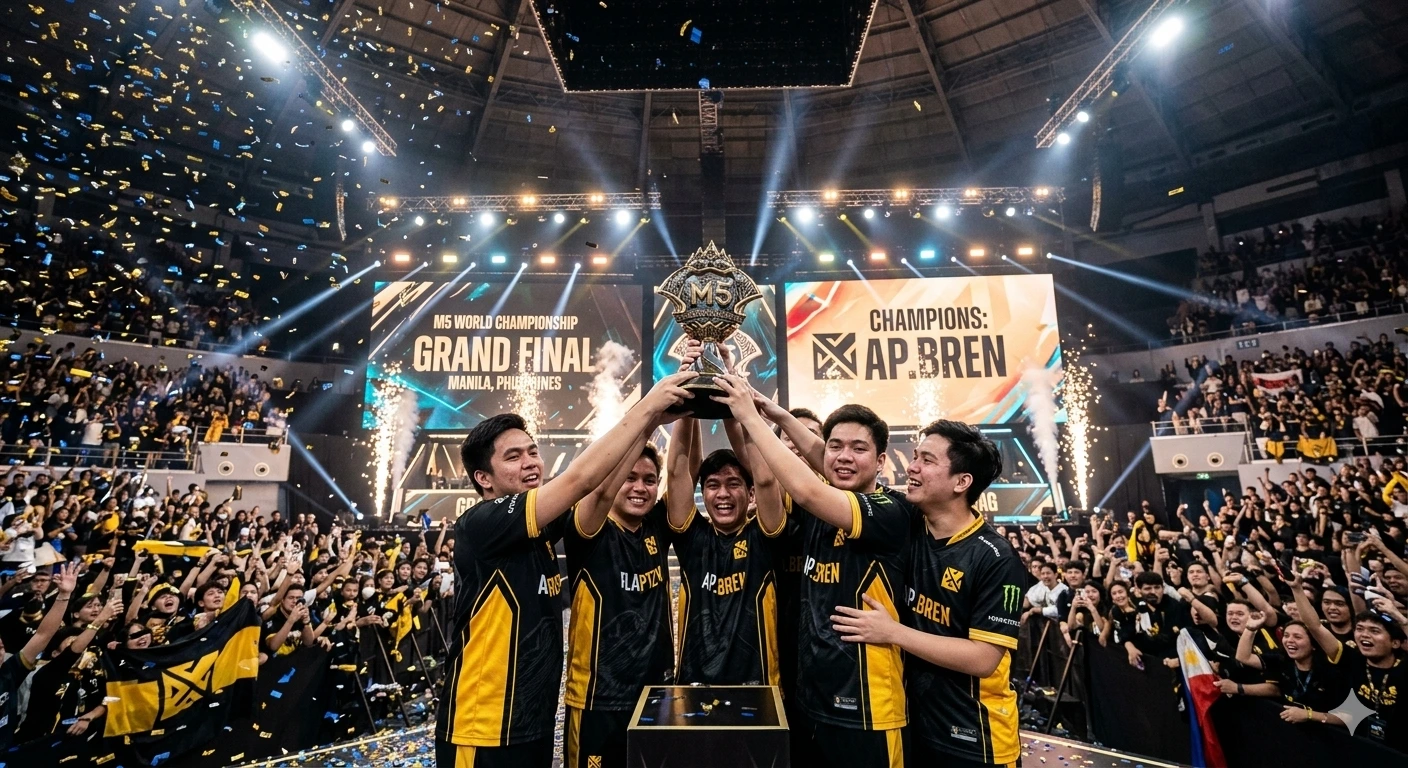
Continuing the geographical expansion, M5 was hosted in Manila, Philippines, in December 2023. This tournament introduced the Wild Card format, expanding the global pipeline to include emerging developmental regions. AP Bren achieved legendary status by securing their franchise’s second world title on home soil, proving that sustained analytical coaching and robust roster depth are mandatory to survive the gruelling pressures of modern international tournaments.
As the circuit advanced into the M6 and the current 2026 competitive seasons, the competitive landscape underwent a massive global diversification. No longer restricted to the traditional powerhouse regions of Indonesia and the Philippines, the tournament integrated highly competitive regional champions from the MENA region, Eastern Europe, North America, and a revitalized Malaysian scene. The modern era of the tournament represents a fully globalized esport where tactical variance, advanced draft simulation AI, and world-class sports science are fully integrated into every organization’s daily operational routine.
The Strategic Role of the M-Series World MLBB Champhionship in the Competitive E-Sports World
The overarching influence of the M-Series World MLBB Champhionship extends far beyond standard competitive entertainment metrics. It functions as the ultimate economic and structural engine for the entire mobile gaming industry. By establishing a formalized, highly visible global destination, it incentivizes regional organizers to maintain rigid professional MLBB tournament tiers. These tiers ensure that local leagues, such as the regional MPL and MCC circuits, possess a direct, merit-based pathway to global exposure and corporate sponsorship.
Furthermore, this premier tournament acts as the definitive trendsetter for the global competitive meta. The strategic draft pick configurations, itemization adjustments, and map rotation paths developed during this tournament immediately trickle down to millions of ranked ladder matches worldwide. It forces a continuous cycle of developer balance updates, ensuring that the gameplay loop remains dynamically evolving and highly engaging for both casual consumers and hardcore analysts.
For the individual viewer and community enthusiast, the tournament serves as an inspirational cultural beacon. It elevates professional mobile gamers into mainstream international athletes, breaking historical stigmas surrounding handheld competitive gaming. The event provides a shared global space where community narratives, cross-border friendships, and intense regional rivalries foster an immensely loyal and continuously expanding digital subculture.
To understand how these international developments integrate into the broader landscape of modern mobile gaming, read our comprehensive analytical pillar guide on Mobile Legends Bang Bang: The 2026 Competitive Benchmark.
Data Comparison Across Historical M-Series Tournaments
To fully appreciate the scale and development of the tournament, we must analyze the structural growth in prize pools, peak concurrent viewership, and regional dominance across its historical timeline. The table below outlines this impressive expansion:
| Event | Host Location | Winning Franchise | Prize Pool (USD) | Peak Viewership |
|---|---|---|---|---|
| M1 (2019) | Kuala Lumpur, Malaysia | EVOS Legends (ID) | $250,000 | ~648,000 |
| M2 (2021) | Singapore (Bubble) | Bren Esports (PH) | $300,000 | ~3,083,000 |
| M3 (2021) | Singapore (Public) | Blacklist International (PH) | $800,000 | ~3,191,000 |
| M4 (2023) | Jakarta, Indonesia | ECHO Esports (PH) | $800,000 | ~4,270,000 |
| M5 (2023) | Manila, Philippines | AP Bren (PH) | $900,000 | ~5,067,000 |
| M6+ (Modern) | International Stages | Global Contenders | $1,000,000+ | Shattering Records |
To see how the massive viewership scaling and financial milestones of the M-Series align with the broader commercial shifts across the global competitive gaming landscape, explore our macro-level analysis on Esports Industry Trends: The Ultimate 2026 Market Manual.
Step-by-Step Evolution of Tournament Mechanics and Qualification Frameworks
The operational framework of the M-Series World MLBB Champhionship has gone through a rigorous engineering process to ensure maximum competitive fairness and international representation. Here is the step-by-step structural process of how the tournament mechanics operate under the modern format:
- Regional Professional Qualification Tier: Franchised and open leagues around the globe run independent qualifiers over several months. Only top-tier champions and designated runners-up secure direct invitations to the main event.
- The Wild Card Offline Stage: Implemented to foster global inclusivity, lower-ranked regions and runner-up teams assemble in a pre-tournament land tournament. They battle intensely for the final remaining slots in the main Group Stage, allowing wildcard underdogs a chance to crash the main party.
- The Group Stage Seeding Matrix: Qualified squads are placed into separate, balanced groups. They compete in a round-robin format designed to test structural versatility across multiple opponents within a condensed timeframe.
- Double-Elimination Bracket Phase: Transitioning to the main arena, teams are split into Upper and Lower brackets based on group standings. This format ensures that a single bad game does not eliminate a world-class roster, rewarding long-term mental stamina and tactical adaptation.
- The Grand Finale Showdown: The two surviving organizations meet in a grueling, best-of-seven series that challenges their mechanical consistency, physical endurance, and strategic composure under extreme competitive pressure.
Frequently Asked Questions (FAQ)
Q1: What makes the M-Series World MLBB Champhionship different from regular regional MPL tournaments?
A1: While regional MPL tournaments establish domestic dominance, the international championship unites global regional winners into a single elite competitive environment, offering substantially higher financial incentives, global ranking points, and ultimate international prestige.
Q2: How has the addition of the Wild Card format affected overall tournament health?
A2: The Wild Card phase has successfully accelerated infrastructure investment within non-traditional regions like South Asia, Eastern Europe, and LATAM, directly diversifying the competitive meta and expanding global media viewership.
Q3: Why are drafting strategies considered the most vital component of the modern tournament?
A3: With professional mechanical skills being nearly equal across elite rosters, matches are often decided during the draft pick phase. Denying comfort heroes, countering meta picks, and hiding pocket strategies routinely dictate the outcome of high-stakes matches.
Conclusion
The M-Series World MLBB Champhionship has indisputably grown beyond the boundaries of a standard mobile gaming tournament. It now stands as a premier global entertainment asset, a massive economic catalyst for professional organizations, and the ultimate competitive peak for millions of players around the globe. Its history is a fascinating timeline of rapid expansion, shifting regional dominance, and remarkable tactical innovation.
As the tournament ecosystem advances through 2026 and beyond, it will continue to refine operational standards, break traditional broadcasting records, and deliver legendary, unforgettable competitive moments. For anyone tracking the future trajectory of digital competitive sports, keeping a close eye on this premier event is absolutely mandatory.
About the Author