
Motorsport Tech Mechanics – The global high-performance racing sector has transformed into a sophisticated hotbed of computing power, advanced materials science, and thermodynamic engineering as we navigate through 2026. Elite racing engineering is no longer defined merely by mechanical raw horsepower or driver instincts; it has evolved into a hyper-calculated digital ecosystem where victories are secured through fractional millimeter design variances and instantaneous edge-computing decisions. Navigating this elite structural arena requires shifting away from surface-level broadcast narratives and adopting a methodical analysis of modern motorsport tech mechanics.
A flawed interpretation of active aerodynamic configurations, fluid dynamics, and energy recovery engineering creates severe strategic blind spots for digital publishers, tech analysts, and automotive professionals. At Nge Online, our operational mission is to translate complex trackside data matrices into highly structured, actionable analytical models. This comprehensive pillar guide serves as the authoritative structural center for our dedicated Motorsport division, reinforcing our broader Global News informational hierarchy.
The Core Physics Foundations of Motorsport Tech Mechanics
Demystifying the modern trajectory of motorsport tech mechanics requires a total baseline reassessment of vehicular balance and power delivery architectures. Historically, racing platforms maximized performance via displacement inflation and unrestricted fuel flow volumes. In 2026, severe structural constraints dictate development pipelines, forcing automotive engineers to prioritize systemic thermodynamic efficiency and extreme energy extraction over simple raw displacement metrics.
To accurately monitor these rapid engineering evolutions, trackside analysts must look past basic top-speed traps on the main straightaway. Real-world evaluation requires a continuous, multi-axis cross-reference of thermal degradation profiles, mechanical grip transfer parameters, and kinetic recovery optimization. Filtering your research through these objective engineering metrics allows you to isolate genuine structural breakthroughs from superficial corporate marketing press releases within the elite racing arena.
| Engineering Pillar | Primary Evaluation Metric | Strategic Objective |
|---|---|---|
| Energy Harvesting | Thermal-to-Kinetic MJ Conversion | Maximizes electrical deployment windows without exceeding battery cell thresholds. |
| Grip Management | Slip-Angle Coefficient Retention | Stabilizes localized tire contact patches throughout multi-hour racing stints. |
| Chassis Rigidity | Torsional Stiffness-to-Weight Ratio | Ensures predictable suspension geometry deflection under severe lateral G-loads. |
Executing Aerodynamic Boundary Optimization and Flow Management
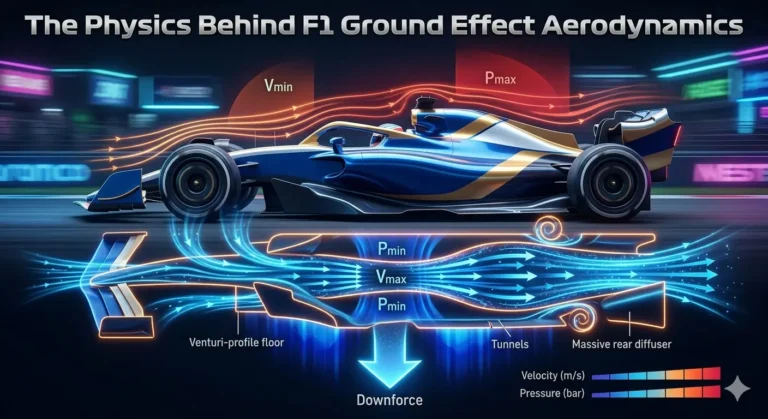
The continuous war against air resistance has pushed modern aerodynamicists into the realm of computational fluid dynamics simulations that rival aerospace deployment models. Achieving true aerodynamic boundary optimization stands as the absolute differentiator between championship-winning platforms and grid-locked mid-tier teams. The objective is no longer simply generating immense downward force; the modern goal centers on cleaning up internal airflow wakes and generating localized vortices that seal the vehicle underfloor against ground anomalies.
This micro-level air management requires a sophisticated engineering balance between passive wing profiles and active venturi tunnel designs. By manipulating under-car air velocities, teams generate low-pressure zones that literally vacuum the chassis to the tarmac, allowing cornering speeds that exceed 5.5 lateral Gs. Tracking these continuous structural modifications requires a granular look at front-wing endplate geometry, wheel-wake redirection vanes, and rear diffuser exit boundaries that dictate total platform stability during high-speed directional changes.
The Complex Intersection of Drag Reduction and Real-Time Wing Deflection
When analyzing the highest-tier racing grids, managing aerodynamic drag on straightaways while maintaining massive downforce through tight sequences is a critical design paradox. High-end platforms implement highly complex structural layups of carbon composite fabrics that flex predictably under extreme air pressures.
This elastic aero engineering allows specific wing elements to alter their real-world profile as velocity mounts, flattening out on long straights to reduce structural resistance and boost top-end speed automatically. As the vehicle decelerates and enters the corner braking zone, the material returns to its high-angle state, instantly re-establishing maximum aerodynamic downforce. This seamless blending of material sciences with raw aerodynamics provides vehicles with an optimized performance curve across diverse racetrack layouts.
Thermodynamics: Sustainable Biofuel Integration and Powertrain Resilience
The internal combustion core of 2026 has undergone a complete chemical revolution. The mandatory deployment of sustainable biofuel integration across premium racing classifications has fundamentally rewritten the rules of engine mapping and internal fuel combustion physics. These advanced, non-fossil synthetic drop-in fuels feature distinct combustion velocities, ignition temperatures, and energy density profiles compared to historical petroleum compounds.
To survive under these new chemical constraints without experiencing massive drops in total thermal output, engine mechanics have completely redesigned piston crown geometries, optimized high-pressure direct injection patterns, and advanced pre-chamber ignition setups. These modifications ensure that synthetic fuels burn with near-perfect volumetric efficiency, turning what was once a green public-relations mandate into a high-performance engineering asset. Sustaining powertrain resilience under these extreme, high-pressure synthetic combustion matrices is a primary focus for modern trackside development teams.
Powertrain Validation Optimization Protocol
- Pre-Chamber Jet Optimization: Tune localized air-fuel mixture ratios inside the ignition pre-chamber to guarantee complete synthetic fuel propagation under ultra-high compression levels.
- MGU-H Harvesting Evaluation: Continuous monitoring of exhaust gas turbine shafts to convert wasted thermal energy into clean electrical reserves with zero turbo-lag penalty.
- Thermal Barrier Coating Check: Apply advanced plasma-sprayed ceramic matrices to internal engine valves to insulate core alloy components from volatile synthetic combustion heat cycles.
Balancing Kinetic Energy Harvesting Systems vs. Raw Thermal Engine Displacement
The modern racing engine is a hybrid masterpiece that splits power generation between physical fuel burning and complex electrical harvesting loops. While the combustion unit provides a baseline of sustained torque, the kinetic recovery systems instantly deploy hundreds of extra electrical horsepower directly into the main drivetrain. Successfully managing this delicate energy balance ensures that drivers can execute high-speed overtaking maneuvers without draining their battery reserves before the lap is completed.
Data Infrastructure: Processing Predictive Telemetry Analytics
Modern victories are no longer mapped out exclusively on pit-wall clipboards; they are calculated inside dense cloud infrastructure networks. The integration of predictive telemetry analytics has transformed real-time race management into a precise, predictive software exercise. Every vehicle on the modern grid functions as an expansive IoT array, outfitted with hundreds of high-frequency data sensors that stream real-time operational metrics back to trackside server racks at gigabit speeds.
This dense data flow monitors everything from individual tire carcass internal temperatures to brake disc structural micro-fissures. Advanced machine-learning algorithms continuously process this information, simulating thousands of predictive race permutations every single second. This automated analysis allows pit strategists to predict the exact lap a competitor’s tires will cross the structural thermal degradation cliff, giving teams the ability to execute perfect under-cut or over-cut pit maneuvers long before the physical performance drop becomes visible on the track.
| Telemetry Stream | Primary Data Sensor Matrix | Strategic Protocol Target |
|---|---|---|
| Carcass Thermal Array | Multi-Zone Infrared Tire Sensors | Prevents compound blistering by identifying localized heat spikes instantly. |
| Suspension Telemetry | High-Frequency Laser Ride-Height Arrays | Maintains optimized underfloor venturi clearance over track curbing variations. |
| Fluid Pressure Systems | Micro-Ultrasonic Internal Transducers | Detects sudden hydraulic pressure drops before terminal engine failure occurs. |
Chassis Engineering: Specialized Metallurgy and Carbon Weave Optimization
Beneath the aerodynamic bodywork lies the true structural core of motorsport tech mechanics—the monococoque chassis structure. Modern vehicle survival cells are constructed utilizing tailored carbon fiber weaves interspersed with specialized titanium structural rings. This advanced material integration guarantees that the survival compartment remains completely unyielding during high-velocity impacts, deflecting devastating crash energies away from the cockpit environment.
Additionally, suspension pickup points and structural wishbones are constructed using high-tier titanium alloys created through specialized laser additive manufacturing processes. This level of fabrication allows engineers to print hollow internal lattice structures that minimize un-sprung weight while preserving absolute structural rigidity. Reducing this un-sprung mass ensures that suspension components respond with instantaneous accuracy to track anomalies, maximizing mechanical tire contact with the asphalt under aggressive cornering maneuvers.
The Realities of Tire Compound Chemistry and Degradation Vectors
The single point of physical contact between the vehicle and the racing circuit is the specialized tire compound matrix. Modern racing tires are volatile chemical compositions of synthetic rubbers, specialized resins, and interlocking silica networks designed to operate within highly restrictive thermal windows. Managing this chemistry requires drivers to carefully balance their aggressive inputs, ensuring the compound stays perfectly within its optimal operating window without triggering surface graining or severe core thermal blistering vectors.
Braking Subsystems: Carbon-Carbon Friction Architecture
Deceleration performance is just as critical to lap-time optimization as raw straight-line acceleration. Modern high-tier racing braking networks leverage advanced carbon-carbon composite brake discs and carbon-fiber pads that operate at extreme thermal thresholds. Unlike conventional automotive brake systems that experience immediate performance fade when temperatures climb, carbon-carbon friction setups require immense heat—frequently exceeding 800 degrees Celsius—to reach their peak friction coefficient numbers.
Managing this high thermal requirement demands sophisticated cooling duct design and real-time electronic brake-balance mitigation. As a vehicle approaches a heavy braking zone at over 330 kilometers per hour, the driver relies on optimized air ducts to feed cold air directly into the center of the spinning carbon disc, venting out extreme heat through hundreds of micro-drilled radial ventilation holes. This precise thermal management ensures perfectly uniform braking pressure and eliminates the catastrophic risk of structural brake disc shattering under sustained high-speed deceleration loads.
Frequently Asked Questions: Advanced Racing Engineering
What is the primary focus of motorsport tech mechanics in 2026?
The dominant development vector focuses on systemic thermodynamic efficiency, driven by mandatory sustainable biofuel integration and advanced kinetic energy harvesting loops. Modern racing engineering prioritizes extracting maximum performance from highly restricted fuel volumes and optimizing electrical deployment strategies rather than inflating raw displacement metrics.
How does aerodynamic boundary optimization directly improve lap times?
By precisely managing underfloor airflow wakes and creating localized low-pressure zones via venturi tunnels, aerodynamic optimization generates massive downward force with minimal drag penalty. This allows vehicles to maintain exceptional stability and carry unprecedented cornering speeds through high-velocity turns without compromising straight-line top speed vectors.
Why is predictive telemetry analytics considered a critical racing asset?
Real-time telemetry streams allow advanced machine-learning algorithms to simulate thousands of predictive race permutations every single second. This continuous data processing grants pit strategists the ability to forecast opponent tire degradation thresholds and preemptively deploy optimized pit maneuvers long before physical performance drops manifest on the track.
Conclusion: Mastering the Future of Elite Automotive Engineering
Navigating the hyper-accelerated, technologically dominant landscape of 2026 motorsport requires an unyielding dedication to objective, data-driven analytical methodologies. By systematically evaluating powertrain validation checklists, monitoring aerodynamic boundary optimization patterns, and tracking real-time predictive telemetry analytics streams, analysts completely eliminate subjective guesswork from performance forecasting. This rigorous empirical framework guarantees that every technological breakdown, race strategy evaluation, and engineering overview delivers unmatched structural clarity.
The ultimate goal of any advanced racing strategy is to construct a balanced, highly responsive mechanical ecosystem that successfully extracts maximum velocity from restricted fuel parameters without inducing premature component failures. As development continues to accelerate across the synthetic fuel formulation and carbon composite printing sectors, remaining anchored to these foundational engineering pillars ensures that your organizational infrastructure remains exceptionally powerful, secure, and fully prepared for whatever innovations manifest next on the global automotive horizon.
About the Author